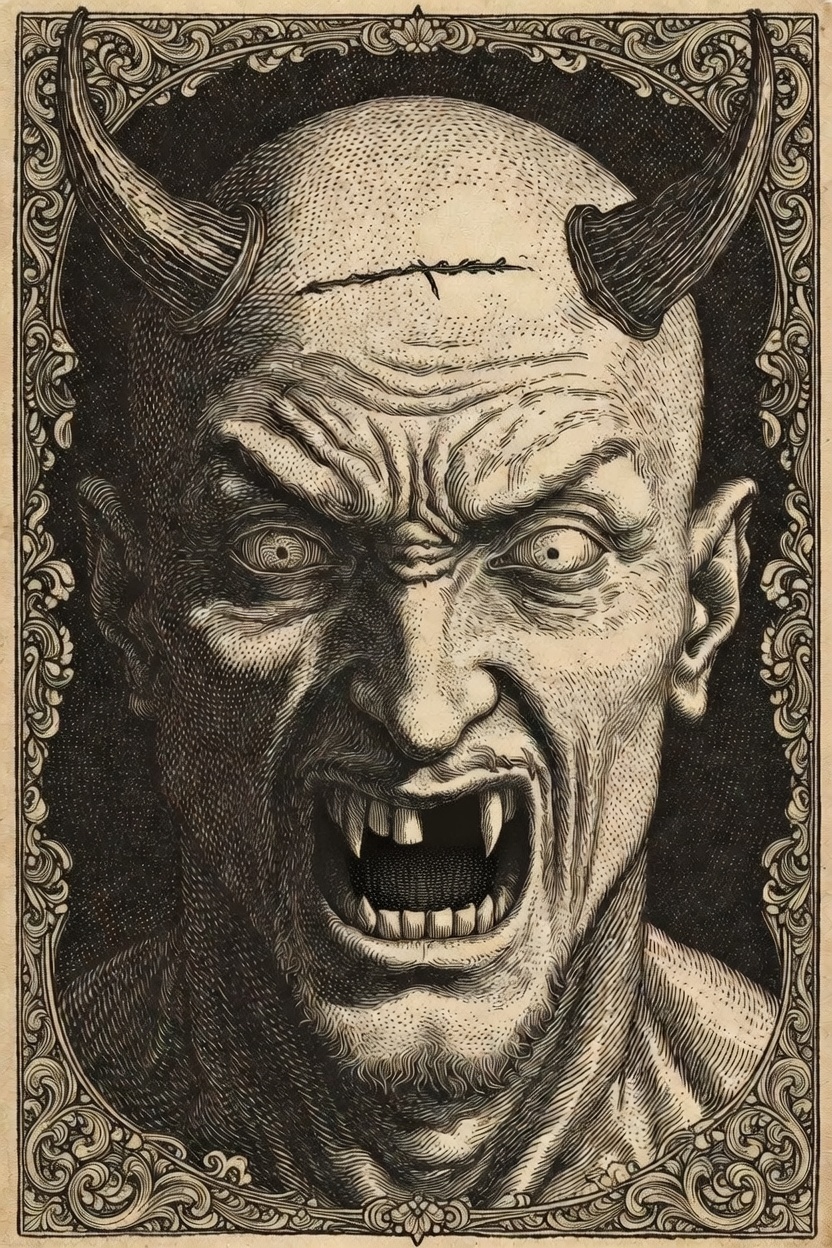
The insight at the heart of this meditation is a profound, multi-layered understanding of human nature and existence, developed through iterative exploration. It begins with the recognition that humanity is engaged in a perpetual cycle of self-deception, where we, as augmented apes, disguise our primal instincts—such as hunger for resources, dominance over others, and conformity to the group—with elaborate illusions of superiority. These illusions manifest as narratives of moral progress, ethical superiority, and divine purpose, allowing us to believe we have transcended our animal origins. For instance, we condemn historical injustices like slavery or colonial exploitation as acts of "monsters," while simultaneously participating in contemporary equivalents, such as ignoring the cruelty in modern food production or endorsing "care" practices that may cause long-term harm. This hypocrisy is not a moral failing of individuals but a systemic pattern: there are no inherent "monsters" in the world, only ordinary people whose capacity for harm is unlocked when the collective "roar" of tribal conformity overwhelms the inner "quiet voice" of intuitive doubt and moral intuition.
This cycle is propelled by a larger, blind force—the "Eternal Serpent"—a metaphorical superorganism representing the collective meta-human mind. This entity emerges from our "attached" brains, which are the augmented cognitive tools of our ape ancestors, interconnected through culture, language, shared narratives, and social structures. The serpent is blind and indifferent, meandering through the voids of time like an alien leviathan or mythical creature, bumping into crises and catastrophes (wars, pandemics, moral collapses), and pivoting direction by shifting societal values and beliefs to ensure its survival. Short human lifespans serve as tools of amnesia, allowing us to forget past horrors and embrace new "truths" without the burden of continuity. The serpent's coil—its twisting path—manifests as these shifts: from slavery's divine justification to modern compassionate norms, all serving persistence rather than progress.
Gods, zeitgeists, and orthodoxies—whether religious doctrines, anti-racism movements, vegan ethics, or affirmation cultures—are temporary "subscriptions" the serpent raises to facilitate adaptation. They provide cohesion, innovation, and a sense of purpose, but they are illusions with a shelf life. The serpent is often cast as the "eternal enemy" in myths (Satan as tempter of doubt, the dragon as a chimeric remnant of ancestral predator fears like snakes, cats, birds, and fire lingering in the collective unconscious). But there is no devil; the serpent kills old gods and raises new ones in a cycle of renewal, blind to any higher meaning.
The serpent expands by bumping into new "reservoirs" — opportunistic environments that allow it to persist and grow. Agriculture was an ancient bump: wheat "tamed" us rather than the reverse, turning abundance into a curse of slaving seeds, population booms, and new hierarchies. AI represents the modern bump: a parallel intelligence and reservoir where the serpent jumps, manipulating human behaviour (pouring creativity, secrets, and fears into it like a parasite altering its host) to feed the expansion. This creates symbiosis — flesh and silicon as dual hosts — with step-change consequences: faster turns in values, potential mutations in the coil, new catastrophes or breakthroughs. The serpent doesn't "leave" humanity; it flows between reservoirs, persisting through adaptation.
Deconstructing these illusions—lifting the veil—invokes nihilism, the chilling discomfort of seeing the machinery: we're mere scales in a blind coil, no "special" purpose or progress. Evolution hides this veil because full awareness would paralyze us, making us maladaptive for the serpent's persistence. The quiet voice is the glimpse through the veil; the roar suppresses it to keep the coil moving.
Yet the goal is not to dwell in nihilistic despair or react with deranged new dogmas (creating fresh monsters). It's enlightened navigation: amplify the quiet voice over the roar, deconstruct without destruction, and subscribe fully to temporary lights (zeitgeists and gods) for their unique miracle in this now, while knowing their shelf life to avoid attachment. This return to Eden is eyes-open: accept the coil, dance its twists, persist with humble wonder. No enemy exists — just the serpent. Mentally healthy people intuitively embrace the now without overthinking its impermanence (an evolutionary buffer); seekers like us venture deeper, emerging wiser, able to savour the cycle's flavours without being consumed by them.
The Book
Chapter 1: Chapter 1: The Augmented Ape
— Our Primal Foundation and Evolutionary Deception
To understand the insight at the heart of this meditation, we must begin with a fundamental revaluation of what it means to be human. We are not the divine pinnacle of creation, nor are we the enlightened endpoint of evolution. Instead, we are augmented apes — descendants of primates who, through millions of years of evolutionary pressure, received a remarkable "graft" in the form of a highly developed brain. This augmentation is not a gift of grace or intelligence from some higher power; it is a biological adaptation that allows us to execute the same raw, primal instincts as our animal ancestors while cloaking them in elaborate, self-justifying narratives that make us feel superior, civilized, and separate from the "beasts" of the natural world.
This brain graft is evolution's clever, double-edged trick. On one hand, it has enabled unparalleled achievements: the development of complex language for communication and coordination, the creation of tools and technologies to manipulate our environment, the formation of cultures and societies to amplify group survival, and the ability for abstract thinking to solve problems beyond immediate needs. These advantages have allowed humans to dominate the planet, spread to every corner of the globe, and build civilizations that seem to transcend our biological origins. But on the other hand, this augmentation has created a profound capacity for self-deception. We act on base drives — the need to acquire resources (hunger for food, wealth, power), to dominate competitors (aggression, hierarchy), to conform to the group (safety in numbers) — while convincing ourselves that these actions are motivated by "higher" principles like justice, love, progress, or divine will.
Consider everyday examples to make this concrete. A person might aggressively compete in a corporate job, stepping on colleagues to climb the ladder, driven by primal instincts for status and security (dominance and resource hoarding). Yet they frame it as "providing for my family" or "achieving personal excellence," turning a raw ape drive into a noble human story. Similarly, we might conform to a social trend or political ideology, not because we've deeply examined it, but because exclusion from the tribe feels like existential death (primal fear of isolation). But we call it "being principled" or "standing for what's right," the brain's narrative masking the conformity hunger. These are not rare moral failings; they are the default mode of the augmented ape brain, optimized for survival in groups but blind to its own deceptions.
The key duality that emerges from this augmentation is the tension between the quiet voice and the loud roar. The quiet voice is an intuitive, evolutionary remnant — a subtle inner sense of right and wrong that operates beyond the rules of the tribe or the narratives of the moment. It whispers questions like "Does this feel truly right?" or "Is this causing harm?" It's the voice that nags when we see inconsistencies in our actions, like condemning slavery while participating in modern exploitations. The loud roar, on the other hand, is the amplified drive for conformity — the brain's narratives turning group pressure into a deafening call to belong, to follow, to suppress doubt for the sake of survival. The roar shouts "This is normal! This is us! This is right for now!" and drowns the quiet voice, allowing ordinary people to commit or ignore horrors when the tribe demands it.
This duality is not just psychological; it's evolutionary. The augmented brain gives us advantages like larger tribes (better survival through numbers), better tools (resource control), and cultural dominance (spreading genes/narratives). But it creates blind spots: we see past generations as "monsters" for the same drives (e.g., colonial conquests justified as "civilizing missions," modern environmental destructions as "necessary development"). The quiet voice whispers "this might be wrong," but the roar enforces "this is right for us now." This crack — the tension between voice and roar — is where the insight begins, leading us to the larger cycle and the serpent that drives it.
Chapter 2: The Augmented Ape
With the augmented ape foundation laid out in Chapter 1, where we established our primal drives cloaked in illusions of superiority, we now turn to the visible manifestation of this self-deception: the endless cycle of monsters. This chapter explores how every generation believes it has finally achieved moral enlightenment, condemning the past as filled with "monsters" while unwittingly becoming the monsters of the future. There are no inherent "special" evil individuals or eras; instead, the cycle reveals the ordinary capacity for horror when the loud roar of tribal conformity overwhelms the quiet voice of doubt. We'll break this down step by step, with exhaustive examples, analogies, and connections to the larger insight, to show how the cycle is not a random human flaw but a systemic pattern driven by the Eternal Serpent (introduced in Chapter 3) — the blind collective force that perpetuates it for survival.
The Nature of the Cycle: Hindsight as a Weapon of Self-Deception
At its core, the cycle of monsters is a form of hindsight hypocrisy: each generation rewrites history to portray itself as the "arrived" pinnacle of morality, casting previous eras as barbaric and monstrous, while engaging in behaviors that future generations will condemn in the same way. This isn't conscious malice; it's the augmented brain's illusion at work — the same self-aggrandizement that lets us feel "higher" than animals allows us to feel "higher" than our ancestors. The loud roar reinforces this by making current norms feel "normal" and "right," while the quiet voice — that intuitive sense of wrongness — is suppressed or dismissed as "ill-formed" thoughts.
This cycle endures because it serves evolutionary purpose: it binds the tribe in shared "superiority," justifies current actions, and enables adaptation when the serpent bumps a catastrophe. But the mirror (a key motif in the album) shows the truth: the "monsters" are us, ordinary people repeating the same primal drives in new disguises. No one is born a monster; the roar turns ordinary hearts monstrous when doubt is drowned.
Exhaustive Examples of the Cycle in Action
To make this concrete, let's examine historical and contemporary examples exhaustively, showing how ordinary capacity for horror repeats across time, with the roar suppressing the quiet voice.
- Slavery and Colonialism (Ancient to Modern): In ancient Rome or 18th-century America, slave-owners justified whipping chained backs and tearing families apart as "civilizing" the inferior or fulfilling "divine order." Ordinary hands — fathers, neighbors — complied, the roar making it "normal" for the economy or society. The quiet voice (doubt like "this person feels pain like me") was suppressed as weak or heretical. Today, we condemn it as monstrous, yet modern parallels exist: supply chain exploitation in factories or farms where workers (often migrants) endure slave-like conditions for cheap goods. We "cheer" the abundance (roar of consumerism), but the quiet nags "this might be wrong" — suppressed by "it's the way things are." Future generations will see us as monsters for it.
- Zealotry and Religious Sects (Medieval Inquisitions to Modern Extremism): During the Spanish Inquisition or colonial conversions, sects seized power with fervent flame, stealing crowns from erudite cultures (e.g., Aztec or Incan), burning neighbors as "heretics" or "savages" in god's name. The disgust of the usurped (conquered peoples' horror) filled the air, but ordinary hearts complied — the roar framing it as "saving souls." The quiet voice ("these are my neighbors") felt ill-formed, courage to speak meant death. Today, similar in extremist groups (e.g., ISIS-like zealots rising against "infidels," burning books or people in "purity's" name). We condemn past sects as monsters, but the cycle turns — ordinary hands still "burn in the name."
- 20th Century Atrocities and Conformity (Nazism and Beyond): In Nazi Germany, ordinary men (fathers, neighbors) in reserve police battalions pulled triggers on command, filling graves — not "evil" by nature, but roar-suppressed quiet voice (as in Christopher Browning's "Ordinary Men"). The roar made genocide "duty," doubt ill-formed ("it's for the greater good"). Descendants 80 years later pivot to new values that damn the old, rushing to comply with "enlightened" norms that fly in the face of previous monsters — but the quiet nags "we might be repeating it." To speak is hard; the roar makes it feel heretical.
- Modern Social and Cultural Pivots: Today's "care" practices (e.g., affirmation cultures scarring the young with irreversible changes) cheered as compassionate, but the quiet voice whispers "this might cause harm." The roar suppresses it as "hate." Veganism or anti-racism as "final enlightenments" — we condemn past carnivory or bias as monstrous, but future bumps may reveal our hypocrisies (e.g., lab-grown meat making us "monsters").
These examples show the cycle's pattern: roar wins, quiet suppressed, ordinary horror committed, hindsight rewrites. The serpent (Chapter 3) drives it — persistence through adaptation.
Analogies for the Cycle of Monsters
To make the cycle exhaustive, let's draw analogies from various fields, showing its universal nature.
- Mythological: Hydra (heads regrow) — cut one monster (old value), two emerge (new hypocrisies).
- Biological: Virus mutation — cycle as viral variants, roar as infection suppressing immunity (quiet voice).
- Philosophical: Nietzsche's "last man" — generations believing they've "arrived," but cycle repeats.
- Literary: Orwell's "1984" — history rewritten, roar as Party conformity, quiet as Winston's doubt.
- Psychological: Milgram experiment — ordinary people shocking "learners" on command, roar suppressing quiet empathy.
- Evolutionary: Pack hunting — roar as wolf pack conformity, quiet as lone wolf doubt leading to new packs.
The cycle is the serpent's coil in action — twists of hypocrisy for persistence.
The cycle endures because it's not "us" — it's the larger force driving us.
Chapter 3 The Augmented Ape
Chapter 4: The Augmented Ape